
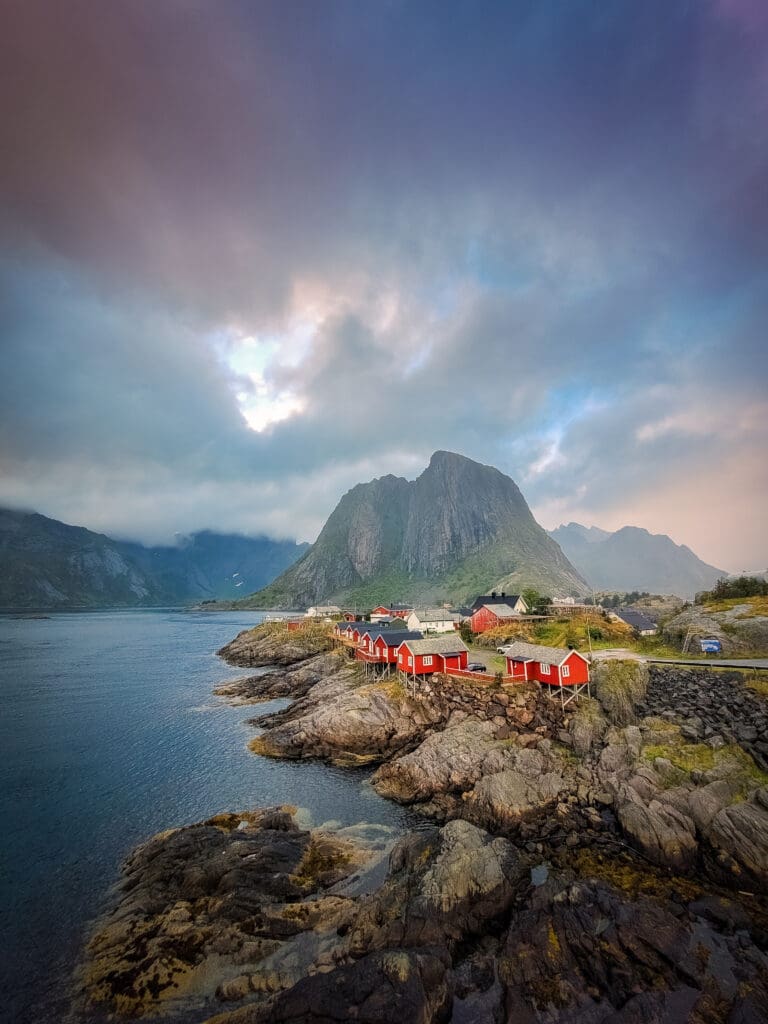
Most people plan a summer Europe trip and think south. The Mediterranean, the coast, the warmth. It’s a reasonable instinct and it produces a reasonable trip. But if someone asked me for an alternative to the Italy or Greece or France trips that everyone seems to be planning at the same time, this is the one I’d reach for first.
Go north.
Scandinavia, Scotland, Ireland, the Baltic states — these places are built for summer in a way that the south simply isn’t. The heat isn’t a problem to manage. The crowds are thinner. The days are so long it feels like you’re getting twice the vacation for the price of one. And the landscape, in summer, is doing something that has no equivalent anywhere else in the world.
Here’s the case, region by region.
Scandinavia: The Midnight Sun
The midnight sun is one of those things you have to experience to understand. The sun doesn’t set, it’s light at midnight, and the sky stays golden for hours in a way that completely reframes what an evening can be. You sit on a terrace at 10pm with the light still warm and the day feeling like it has no intention of ending — and you realize you’re getting more out of every single day than you would almost anywhere else.
Norway is the obvious entry point. The fjords in summer — the Geirangerfjord, the Nærøyfjord, the Sognefjord — are extraordinary in any season but summer gives you the best light, the most accessible hiking, and the boats running their full schedules. Bergen is a beautiful city that most Americans treat as a day trip and should treat as a base. Flåm, at the end of one of the most scenic railway journeys in Europe, is worth the detour.
Sweden in summer is a different proposition — quieter, more spread out, and centered on the archipelago. Thirty thousand islands scattered east of Stockholm, where the Swedes have been spending their summers for generations. Small wooden villages painted that particular shade of red that only exists in Scandinavia. The light at 10pm on the water. Travelers who make it to the Swedish archipelago don’t lead with Stockholm when they get back. They lead with the islands. Every time.
Denmark offers Copenhagen, which is one of the great European cities and at its most alive in summer — the outdoor restaurants, the harbor swimming, the cycling culture that makes the whole city feel like it’s in on a secret. The Michelin-starred Noma may have closed its doors, but the dining scene it seeded has made Copenhagen one of the best food cities in the world. Three or four days here, then north into the Danish countryside or across to the coast, is a summer trip that consistently surprises people who expected less.
When to go
June and July for the midnight sun at its most extreme. Late June through August for the warmest weather and the full summer atmosphere. Pack layers regardless — Scandinavian summers are warm but the evenings can turn quickly.
Scotland: The Long Scottish Summer
Scotland in summer is one of the most quietly extraordinary travel experiences available in Europe, and it is consistently underestimated by travelers who associate it primarily with rain and midges. Both are real. Neither is the whole story.
The Highlands in June and July are as green as anything you’ll see anywhere — the kind of green that comes from all that rain and repays it in landscape. The light, when it comes, is unlike anything in the south: softer, more atmospheric, doing things to the lochs and the heather that photographers specifically plan trips around. The days are nearly as long as Scandinavia’s. By late June, Edinburgh doesn’t get fully dark until nearly midnight.
Edinburgh is the logical base — one of the great European cities, with a castle on a volcanic rock at its center and a medieval Old Town and a Georgian New Town and a restaurant scene that has grown into something genuinely serious. June and early July are the sweet spot before the August Festival crowds arrive and the city doubles in population. The drive north from Edinburgh into the Highlands — through Perthshire, into the Cairngorms, up to Inverness and beyond — is one of the great road trips in Europe and entirely achievable in a week.
For the islands: Skye is well known and justifiably so, though it has become busy enough in summer that arriving with a plan matters. The Outer Hebrides — Lewis, Harris, the Uists — are for the traveler who wants something wilder and more remote. The beaches on the west coast of Harris are white sand and turquoise water that would not look out of place in the Caribbean, and they are almost always empty.
When to go
June is the sweet spot — long days, the landscape at its greenest, the midges not yet at full force. July is excellent. Avoid August if you want Edinburgh without the Festival crowds, though the Festival itself is worth a trip on its own terms.
Ireland: Slower Than You Remember
Ireland rewards the traveler who goes slowly, and summer is when going slowly is easiest. The country is small enough that you can cover significant ground without rushing, and large enough that most visitors only scratch the surface.
Dublin is the entry point for most and deserves more time than it usually gets — two or three days in the city before heading out, not a single night before catching the first bus west. The food scene has genuinely transformed in the past decade; the Dublin that existed twenty years ago and the Dublin that exists now are two different cities in terms of what’s on the table.
The west coast is the argument for going. The Wild Atlantic Way, which runs from Donegal in the north to Cork in the south, encompasses some of the most dramatic coastline in Europe. The Cliffs of Moher are well known and busy; the coastline north and south of them is just as dramatic and considerably quieter. County Clare, Connemara, the Dingle Peninsula — each one justifies a few days of genuine exploration.
The country house hotels of Ireland are a particular pleasure: properties like Adare Manor in Limerick or Ashford Castle in Mayo that have been receiving guests for a century and have gotten very good at it. These are not just places to sleep — they’re the experience. Build the trip around them.
When to go
June and July offer the best combination of long days and reasonable weather. August is busier and the west coast can be unpredictable. Pack a waterproof layer regardless of when you go — the Irish weather is part of the character of the place.
The Baltic States: The Overlooked Summer
Estonia, Latvia, and Lithuania are three of the most under visited countries in Europe and three of the most rewarding for the traveler who makes the effort. The medieval old towns of Tallinn, Riga, and Vilnius are among the best-preserved in Europe — the kind of cobblestoned, cathedral-spired, centuries-layered cities that people go to Prague to find and find much more genuinely in the Baltics, without the crowds.
Summer is when these cities are fully alive. The outdoor café culture, the long evenings, the music festivals that fill the parks and squares — the Baltic summer has an energy that’s easy to underestimate from the outside. Tallinn in particular is one of those cities that consistently exceeds expectations: the Old Town is a UNESCO World Heritage Site, the food scene has become genuinely interesting, and the proximity to Helsinki — a two-hour ferry — makes a combined trip entirely logical.
The Baltic coast itself — Pärnu in Estonia, Jūrmala outside Riga, the Curonian Spit in Lithuania — offers a quieter counterpoint to the cities: beaches, pine forests, the particular atmosphere of the Baltic Sea in summer, which is warmer than you’d expect and considerably less crowded than any Mediterranean alternative.
When to go
June through August. The cities are at their most alive, the coast is warm enough to swim, and the days are long. July is peak season but the crowds are nothing like the Mediterranean. This is a part of Europe where high summer is genuinely manageable.
There is something quietly satisfying about coming home from a summer trip and having people ask where you went — and watching their faces when you tell them The Isle of Skye. Or Estonia. Or the west coast of Ireland. Not because you were trying to be different, but because you were paying attention. Northern Europe in summer is the choice that makes you look like someone who actually knows what they’re doing. Which, after reading this, you do. If any of it is calling to you, I’d love to help you put it together properly, then let’s chat.


