
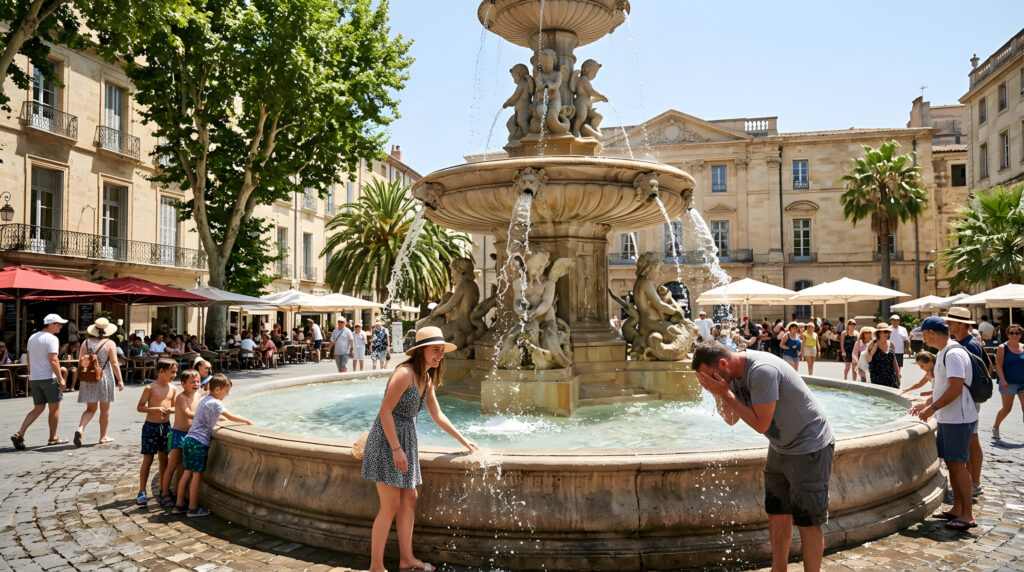
Let’s be honest about something. The advice to “avoid Europe in July and August” is useful for exactly the people who don’t need it. If you have school-aged children, a school calendar, or a job that shuts down in summer, you don’t have the luxury of going in September. July is July. August is August. And Europe in summer, crowds and heat and all of it, is what’s on the table.
So let’s talk about how to actually do it well.
Because the problem with summer in Europe isn’t that it’s impossible. It’s that most people approach it without the information that would make it significantly better. A few things I’ve learned, some from experience, some from watching clients navigate it year after year, that the brochures don’t mention.
Ask About the Air Conditioning Before You Book
This sounds like a small thing and it is not a small thing. European hotels have a complicated relationship with air conditioning that Americans find baffling until they’ve spent a sleepless night in a beautiful room in Florence in July with the windows open and the heat radiating off the street below.
There is a difference between a hotel that has true air conditioning (the kind that cools a room to a temperature you set and keeps it there) and a hotel that has “climate control,” which in practice often means a system that takes the edge off but won’t get the room below 24 degrees Celsius no matter what you do with the dial. Ask the question directly before booking: does the room have true air conditioning? Can the temperature be controlled by the guest? Older properties in particular (the charming ones, the ones in historic buildings) are the most likely to disappoint on this front.
A hot room ruins a trip faster than almost anything else. It’s worth asking.
Plan Your Day Around the Heat, Not Against It
Southern Europe in July and August is genuinely hot: Rome, Barcelona, Athens, the whole Mediterranean south. Fighting the heat by trying to do everything anyway is a choice, and it’s usually the wrong one.
The better model is the one the locals have been using for centuries: be out early, when the morning is still cool and the light is beautiful and the sites haven’t yet filled. By ten or eleven, find somewhere to sit: a café, a shaded terrace, a museum that’s magnificent and air conditioned and nobody queues for because everyone is out sweating at the obvious sites. Midday and early afternoon belong to a long lunch, a rest, a cold drink somewhere quiet. Then out again in the late afternoon, when the heat has peaked and the light has turned golden and the city comes back to life.
This rhythm feels indulgent to people who are used to maximizing every hour. It is also the reason Europeans look so much more comfortable than tourists in summer. The day has a shape that works with the climate rather than against it. Trust it.
Choose Your Sites Strategically
The Colosseum in August is an experience. Not necessarily a good one. Two hours in a queue in full sun, then two hours inside with thousands of other people having the same experience, and then back out into the heat. The Colosseum is extraordinary. It will still be there in September.
For the sites that must be done in summer, book the earliest available entry time and book it well in advance. The difference between arriving at the Uffizi at 8am and arriving at 11am in July is the difference between a morning you’ll remember for the art and a morning you’ll remember for the crowd. Most major sites now offer timed entry. Use it.
And seek out the sites nobody queues for. Every major European city has them: the museum that’s every bit as good as the famous one three blocks away but gets a tenth of the traffic, the church with the Caravaggio that isn’t in the guidebook, the neighborhood that rewards an hour of walking with no agenda. These are often the moments people remember most, because they happened without a crowd around them.
A Word on Where You Stay
In summer, neighborhood matters more than it does the rest of the year. A hotel in the middle of a tourist zone means waking up to crowds that have already formed before breakfast. A hotel one neighborhood over (still central, still convenient, just slightly away from the main drag) means a different quality of morning entirely. It’s worth asking someone who knows the city well which neighborhoods to prioritize, because the answer is different in Rome than it is in Barcelona than it is in Paris.
A shaded terrace or courtyard is worth requesting specifically. So is a higher floor, which catches more breeze. So is proximity to a park or garden, which is cooler than stone streets and gives you somewhere to retreat to that isn’t a museum or a restaurant.
If You Have Any Flexibility at All
June is meaningfully better than July almost everywhere in Europe: longer days, lower prices, the season fully open but not yet at peak capacity. September is better still for most destinations. If the school calendar gives you any room at all (a week in late June, a trip that starts in late August and runs into September), use it.
And consider destinations that handle summer better than others. Northern Europe (Scandinavia, Scotland, Ireland, the Baltics) doesn’t have the heat problem and doesn’t have the crowd problem to the same degree. The days are extraordinarily long, the landscape is at its most alive, and you can walk through a city in July without feeling like you’re competing for oxygen. More on those destinations next week.
For the Mediterranean, the less-famous alternatives often deliver the same experience with a fraction of the crowd. The Amalfi Coast is beautiful and genuinely difficult in high summer. Puglia, two hours east, has the same light and the same food culture and a fraction of the traffic. Santorini is iconic and overwhelmed. Milos, an hour away by ferry, is quieter and in some ways more beautiful. These swaps aren’t compromises. They’re upgrades, depending on what you’re actually going for.
Summer in Europe is worth doing. It just rewards the people who go in with a little more information than the average tourist. That’s what I’m here for.
If summer Europe is on your calendar, whether the dates are fixed or still flexible, let’s talk through what would make it as good as it can be. Let’s chat


