
I get the impulse to see everything. I really do. Time is short, the flight over is long and expensive, you are not sure when you will be back, and so the plan swells. Four countries, then five, a night here, two nights there, the whole continent crammed into ten days like a carry-on you have to sit on to zip shut. The instinct makes complete sense. It is also how people come home needing a vacation from their vacation.
There is a real difference between a trip that gives you the feeling you have done Europe and one that leaves you feeling done in by it. The greatest-hits version, four countries in ten days, tends to produce the second. A trip that puts two countries together with some thought, and gives you enough time in each to actually land somewhere, tends to produce the first. I have watched both happen many times, and the second kind of traveler always comes home happier.
Here is the math I run in my head before I will bless a combination. Every border crossing or short flight costs you the better part of a day, once you count the packing, the transfer, the airport, the wait, and the fog you arrive in on the other side. String four countries together and that is three of those days gone before you have seen a single thing worth flying for. Two countries, and it is one. That one reclaimed day is usually the difference between standing somewhere… and actually being there.
So the combinations that work are the honest ones. The countries genuinely belong together, close in geography and in logistics, ideally tied by some thread that gives the whole trip a shape instead of a checklist. Two of them, with room to breathe. Three, occasionally, if the third is small or right next door. And a route that does not have you doubling back or losing a day to a connection you could have planned around.
A few combinations I would actually put my name on.
Portugal and Morocco
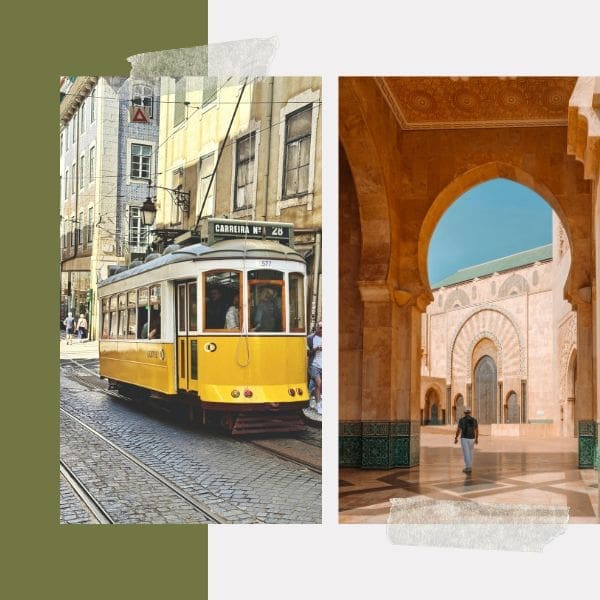
This is the one that both surprises and satisfies people the most. The direct flight from Lisbon to Marrakech is about ninety minutes, shorter than a lot of domestic hops back home, which means you can spend a week in Portugal and then step off a plane into a world that could not feel more different, with no punishing travel day in the middle. The contrast is not a side effect here. It is the whole point.
Portugal is soft light and the kind of melancholy beauty that sneaks up on you, the Atlantic at the edge of everything, a country that has spent centuries quietly watching the world go by and seems perfectly content about it. Morocco is color and noise and spice and a medina that disorients you in the best possible way the first time you walk into it. Put them back to back and you get a trip with real range, two completely different cultures inside one two-week window, and none of the heroics.
Give Portugal the first week. Start in Lisbon, two or three nights, long enough for the miradouros, the tiled façades, and one evening of fado that is not staged for a tour bus. Then pick your second stretch based on the trip you actually want. The Alentejo if you want quiet, cork oaks, walled towns like Évora and Monsaraz, and wine that is criminally underrated. The Douro if you want the river, the terraced vineyards, and a few nights at a quinta where the view does most of the work and you do almost none. One of the reasons I keep returning to Portugal is the light. It does something to the white walls of an Alentejo town in the late afternoon that I have not seen it do anywhere else, and I have looked.
Then Morocco. Marrakech is the usual landing point, and deservedly so. The medina overwhelms you in the best way, the Jardin Majorelle and the Saadian Tombs reward a slow morning, and the rooftop terraces at dusk, when the call to prayer goes up across the whole city at once, tend to stay with people for years. If you have the days, the Atlas Mountains are ninety minutes away and feel like another country entirely, all Berber villages and switchbacks and air that clears your head. Fes is the older, more serious sibling if you want craft and history over polish. And Essaouira, out on the coast, is where you go to exhale: wind off the Atlantic, gulls, grilled fish, and not one ounce of the intensity of the interior.
Sequencing matters more than people expect. Start in Portugal, where the pace is gentle and the jet lag is forgiving, and let Morocco be the crescendo. Do it the other way, from the full volume of Marrakech down to the quiet of Lisbon, and the trip deflates a little right at the end. Build toward the big experience, not away from it.
One real piece of advice on Morocco. It rewards having someone who knows it in your corner more than almost anywhere I send people. The medina in Marrakech is a genuine maze, the riads run from extraordinary to entirely forgettable with very little online to tell them apart, and the gap between a guide who opens real doors and one who simply points at things is enormous. This is not a place to wing it. It is also not a place where the most expensive option is automatically the right one, which is a sentence I wish more of luxury travel believed.
On timing, skip high summer, when Marrakech sits well above a hundred degrees and the medina becomes an endurance event. Spring and fall are the sweet spots, roughly March into May and September into November, when Portugal is at its best and Morocco is warm enough to enjoy without planning your whole day around the nearest patch of shade.
Slovenia and Croatia
Slovenia is one of the least visited countries in Europe, a fact Slovenians seem entirely at peace with. Ljubljana, the capital, is small, walkable, and lovely, the kind of place most travelers blow through in a single day on their way somewhere else. Give it three. The old town, the castle looking down from its hill, the cafés strung along the Ljubljanica River, the open-air market on a Saturday morning when half the city seems to be out buying flowers and catching up. There is a quality of life here you feel by the first afternoon. And the food has become a reason to come on its own. Hiša Franko, out in the Soča Valley, is one of the most celebrated restaurants in this corner of the world, and Ljubljana itself now takes eating seriously in a way that surprises anyone who has not been paying attention.
From the capital, Lake Bled is forty-five minutes. The photographs, for once, are not lying. The lake, the little island church, the castle on its cliff, the Julian Alps standing behind the whole composition as if placed there for the postcard. Get there early, before the day-trippers, and it is one of the more astonishing places in Europe. If you want Bled without Bled’s crowds, Lake Bohinj is twenty minutes deeper into the mountains, with far fewer people and the better setting for an actual swim. The Soča Valley, west of there, is for anyone who wants river gorges and waterfalls in a green that looks faintly invented. And if you have a spare day, the Postojna caves and the cliff-built Predjama Castle nearby are that rare attraction that lives up to the brochure.
Crossing from Slovenia into Croatia is a natural move, and the smart way to do it is to start on the Istrian peninsula, which most American travelers skip entirely on their rush to the famous coast. Their loss. Rovinj is a Venetian-flavored town stacked onto a small peninsula, one of the prettier places on the whole Adriatic, with a fraction of the crowds Dubrovnik pulls. Inland, the hill towns of Motovun and Grožnjan look out over the vineyards and oak forest where the truffles come from. Istria’s food rivals anything across the border in Italy at noticeably gentler prices, and between the wine, the olive oil, and the autumn truffles, you could happily build a few days around eating and call it a cultural itinerary.
Then south down the Dalmatian coast, if the trip has room for it. Split is built inside a Roman emperor’s retirement palace that people still live and shop and argue in, which never quite stops being surreal to walk through. From there the islands open up: Hvar and Korčula for most people, Vis for the ones who want it quieter and a little harder to reach. Dubrovnik makes a beautiful finale if you are smart about timing, inside the walls early or late, when the cruise ships are not. Inland, the lakes and waterfalls at Plitvice are worth the detour if you would rather end on water and forest than on one more old town. What I know about the Dalmatian coast is that the mistake I see most often is people trying to do all of it. Pick three or four anchors, give them room, and let the rest wait. There will be a next trip. There always is.
Then south along the Dalmatian coast if the itinerary allows — Split, the islands, and for those who want it, Dubrovnik at the end. Two weeks covers this combination well if you move at a reasonable pace and don’t try to do everything.
The Baltics: Estonia, Latvia, and Lithuania
Last week I made the case for Northern Europe in summer, and the Baltics were a big part of that argument. They earn their own mention here because they are one of the rare cases where a three-country trip holds up inside two weeks, instead of just looking like it might on a map.
The reason is geography and scale. Tallinn to Riga is a four-hour drive or a quick flight. Riga to Vilnius is about the same. And the three capitals are distinct in a way that matters, which is the part that makes the trip sing rather than blur. Tallinn is medieval and compact, a fairy-tale old town with a surprising amount of tech-forward energy humming underneath it. Riga is grander and more Central European in feeling, home to the largest collection of Art Nouveau architecture in the world, street after extravagant street of it. Vilnius is the most baroque, the most overlooked, and to my mind the most rewarding, a city that has not yet learned to perform for visitors and is all the better for it. Three capitals, one clean line, a clear beginning, middle, and end.
Four or five days per country is the right pace if you want to get past the capitals, which you should. Estonia gives you the islands, Saaremaa and Muhu, where the pace drops to almost nothing and a few of the old manor houses have been turned into lovely small hotels, plus Lahemaa National Park along the coast. Latvia gives you the seaside at Jūrmala, twenty minutes from Riga and lined with wooden Art Nouveau villas, and the castles and forest of the Gauja Valley around Sigulda. Lithuania gives you the Curonian Spit, a slim ribbon of pine forest and enormous sand dunes between the lagoon and the open sea, plus the island castle at Trakai and the Hill of Crosses near Šiauliai, which is exactly what it sounds like and tends to move people more than they expect.
The logistics could not be much easier. You can drive the whole route on good roads, and as of last year there is finally a direct train between Vilnius and Riga if you would rather hand off the wheel. English is widely spoken, the distances are short, and the value next to Western Europe is significant enough to notice. Go in summer if you can, when the daylight stretches close to midnight and the festival calendar fills up. The Baltic Song and Dance Celebrations, held only every few years, are one of the great cultural spectacles in Europe and almost completely unknown to American travelers. This is a trip that consistently exceeds expectations, partly because it is wonderful and partly because most people show up with none.
The multi-country trip works when the combination is honest. When the countries actually belong together, and the itinerary gives each of them room to breathe instead of asking them to share one overstuffed week. If you are weighing a pairing that is not on this list, or if one of these has quietly moved into your head and started unpacking, I would love to help you think through the routing and the timing. So let’s chat.


