
The Case for Mediterranean Islands
We have a funny habit when we plan Europe. We treat the islands like dessert.
Do Rome and Florence, then tack on a few days in Sicily. See Athens, then squeeze in a Greek island before the flight home. Move through Dubrovnik and Split, then give Hvar whatever days are left. The island is where we go after we’ve done the serious traveling.
I think we have that backward.
A Mediterranean island vacation doesn’t have to be the exhale at the end of a bigger trip. Choose the right island, and it can hold the whole thing: history and food, villages and cities, mountains and vineyards, long lunches and genuinely interesting days, with the sea always somewhere in the picture. Sometimes the island isn’t the add-on. It’s the trip.
Why choose a Mediterranean island vacation? The right island can give you the history, food, culture and variety of a larger European trip without requiring you to change hotels every few days. Islands such as Crete and Sicily have enough depth for an entire vacation, while Croatia’s islands can make the journey between places part of the experience.
An island changes the rhythm of a trip
Part of this is simply geography.
On the mainland, it’s very easy to keep going. Florence is only a train ride from Rome. Venice isn’t that much farther. And once you’ve added Venice, well, perhaps you should see Lake Como while you’re there…
I’ve seen what happens next. A trip that started as ten lovely days in Italy becomes a military campaign involving four hotels, three train stations, two private transfers, and a suitcase that never quite gets unpacked.
An island puts a boundary around things. You arrive. You unpack. And instead of immediately calculating how to get to the next place, you start looking more closely at the one you’re in.
That’s not an argument for doing nothing. Quite the opposite. The Mediterranean islands can give you ancient sites, mountain villages, vineyards, fishing harbors, extraordinary food, hiking, sailing, cities, archaeological ruins and a swim before dinner if you feel like it. The difference is pace. You’re no longer measuring the success of the trip by how much ground you’ve covered.
I’ve made this argument before in other forms because I believe it rather strongly: seeing more isn’t always experiencing more. There is a point at which another hotel, another transfer and another pin on the map stop adding to a trip and start taking something away from it. Islands have a useful way of making you notice that.
No, an island trip doesn’t have to mean a beach vacation

Say Mediterranean island and the mind supplies the photograph almost automatically. Blue water. White umbrellas. You, only inexplicably more attractive, holding an Aperol spritz.
Nothing wrong with any of that. But reducing an island to its beaches misses most of what makes the interesting ones interesting.
Crete has Minoan history, mountain villages, gorges, olive groves and a food culture deeply connected to the land. Sicily has Greek temples, Baroque cities, volcanoes, vineyards, fishing towns and layer upon layer of civilizations that left something behind. On Croatia’s islands, medieval towns and old maritime communities sit along an Adriatic coast that has been traveled for centuries. The beach may be lovely. It may not even be the reason to go.
Madeira makes the point particularly well, even though it sits in the Atlantic rather than the Mediterranean. I’ve traveled there with my family, and what makes the island so compelling to me isn’t a classic beach experience at all. It’s the interior. Madeira rises dramatically from the sea into mountains, deep green valleys and the network of levadas that threads through the landscape. You can spend the day walking through scenery that seems determined to prove how many shades of green exist, then come back down toward the coast for dinner.
That’s an island vacation too. Maybe that’s the better way to think about islands in general: island describes the geography. It doesn’t tell you what kind of trip you’re going to have. That depends entirely on which island you choose.
The Mediterranean doesn’t have one island personality
This is where the phrase Mediterranean islands becomes almost comically broad. A Croatian island and Crete are not interchangeable. Sicily doesn’t feel like either one. And that’s before we wander toward Mallorca, Menorca, Corsica, Sardinia, Malta, or the dozens of Greek islands with personalities all their own.
Same sea. Completely different trips.
I’m going to spend September looking more closely at three versions because together they make the point beautifully.
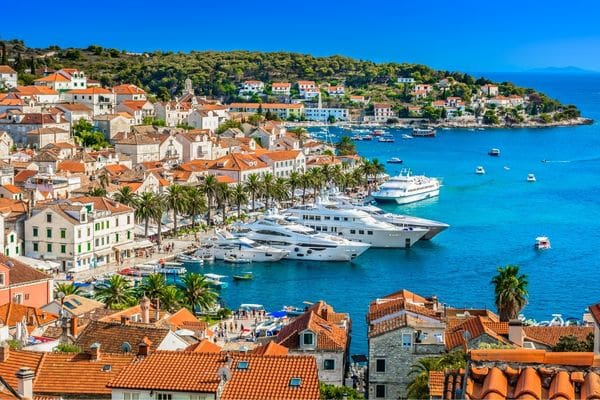
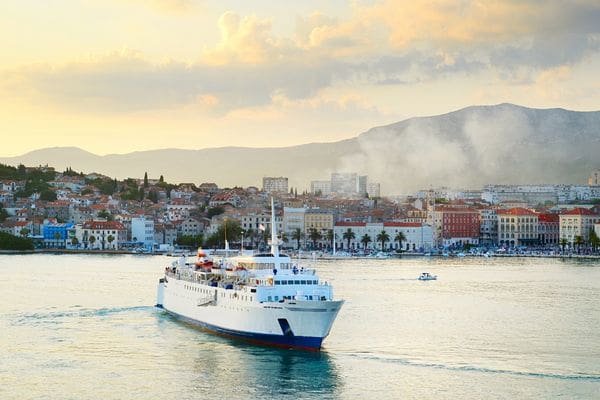
Croatia is the argument for movement. The Adriatic lends itself to a trip where the islands become part of the journey itself. You can move between coastal towns and islands without the trip feeling like a series of disconnected stops, particularly when some of that movement happens on the water. The question there isn’t necessarily which one island should I choose? It may be which combination creates the right journey?
Crete is the argument for staying. It’s large enough and varied enough that treating it as a quick Greek-island stop doesn’t make much sense to me. The more interesting question is what happens when you give one island enough time. Coast, mountains, archaeology, villages, food, wine… you don’t need to leave simply because four days have passed.
And then there’s Sicily, which almost makes the word island feel inadequate. Its scale alone changes the conversation, but so do its history and regional differences. Palermo is not Taormina. The southeast is not the west. Mount Etna brings an entirely different landscape and wine culture into the equation. Sicily can fill a trip without trying very hard.
Three islands. Three completely different arguments for going. Which is exactly why choosing an island based on the prettiest photograph is not terribly useful.
Should you stay on one island or island-hop?
Stay on one island when depth and a slower pace matter more to you; island-hop when the movement itself is part of the experience and each stop gives you something genuinely different.
There isn’t a universally correct answer. There is, however, a correct answer for the trip you’re trying to have. Some islands reward settling in. Others make a compelling case for moving between them.
| Stay on one island when… | Island-hop when… |
|---|---|
| The island has enough depth and variety to reward more time | Nearby islands offer genuinely different experiences |
| You want to settle into a place | Movement is part of the pleasure |
| You’d rather unpack once | You don’t mind changing hotels or bases |
| Food, culture and slower days matter more than covering ground | Variety is one of the reasons you’re going |
| Another transfer feels like work | The journey between islands is part of the experience |
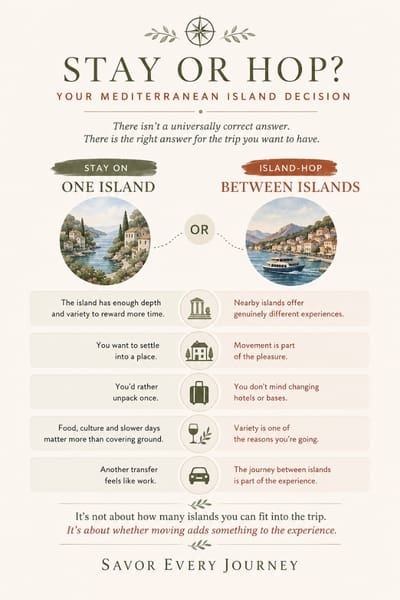
The question isn’t really how many islands you can fit into the trip. It’s whether moving adds something to the experience.
In Croatia, for example, the ferry ride from one island to another can be part of the pleasure. The landscape changes. The town changes. Dinner changes. Moving gives you something.
On Crete, I’d make the opposite argument. There’s so much history, food, landscape and variety within the island that leaving after three days simply to say you’ve been somewhere else can make the trip thinner rather than richer.
And Sicily complicates the question even further. You can stay on one island and still have a trip with several distinct chapters. Palermo, the southeast and the slopes of Etna hardly feel like variations on the same place.
Every move has a cost, not just financially, but in time and energy. You pack. You check out. You get to the port. You wait. You cross. You transfer. You check in. Suddenly a day that looked beautifully efficient when you drew it on a map has been mostly about luggage.
Sometimes luxury is removing one.
The shoulder seasons may be the real luxury
There’s another habit worth questioning: assuming a Mediterranean island belongs to July and August. For many Mediterranean islands, late spring and early fall can offer a better balance of pleasant weather, fewer peak-season crowds and a more relaxed pace than July and August.
Summer has obvious advantages. The days are long, the sea is inviting, restaurants and seasonal businesses are in full swing, and that Mediterranean summer atmosphere is very real. So are the crowds and the heat.
For many travelers, particularly those who aren’t tied to a school calendar, late spring and early fall deserve serious consideration. September can be especially appealing in parts of the Mediterranean: summer hasn’t entirely let go, but the character of a place can begin to change as the peak crowds ease.
That does not mean every Mediterranean island has the same ideal season. They don’t. Ferry schedules, seasonal hotels, weather patterns and sea conditions vary, and an island that works beautifully in October isn’t proof that every island will. Timing is part of choosing the island.
And if your time is finally your own, this is one of the great advantages of using it. You don’t necessarily have to go when everyone else can go.
Sometimes the island belongs with the mainland
After spending this entire article making the case for letting an island stand on its own, I should complicate the argument. Sometimes combining one with the mainland is exactly right.
Athens and Crete can make sense together. Dubrovnik and the Croatian islands have an obvious relationship. Sicily can be paired with mainland Italy if you have enough time to do both justice. The problem isn’t combining them. It’s treating the island as the three-night recovery period after an itinerary that was already too full.
If you’re going to cross the water, give yourself enough time for the island to become a place rather than scenery.
This is also where logistics matter more than people expect. A line on a map doesn’t tell you how often a ferry runs, how long the transfer to the port takes, whether the flight connection eats most of a day, or whether changing hotels one more time is going to make the trip noticeably worse. Those aren’t glamorous questions, but they are very often the questions that determine whether a trip feels effortless.
So which Mediterranean island is yours?
That’s the harder question. And I don’t think the answer starts with a list of the ten prettiest islands in the Mediterranean.
It starts with you.
Do you want to unpack once, or do you love the feeling of moving through a region? Do you want serious history with your sea view, or are you perfectly happy if the day’s biggest decision is lunch?
Are you choosing the trip for food and wine? Hiking? Ancient sites? Small towns? Sailing? A beautiful hotel and nowhere particularly urgent to be? Do you want polished and easy, or are you willing to work a little harder to get somewhere that feels more remote?
And perhaps most importantly: what do you want the trip to feel like?
That’s the question underneath most good travel planning, and islands make it particularly clear.
Over the next few weeks, I’m going to look at Croatia’s islands, Crete and Sicily individually. Not because I think those are the only Mediterranean islands worth considering. Far from it. I’m using them because they’re three very different answers to the same question.
Then we’ll put the pieces together and talk about how to choose.
Make the island the point
There will always be another city you could add. Another ferry you could catch. Another hotel you could squeeze in. Another place close enough on the map to make you wonder whether you’re wasting an opportunity by not going there.
You’re not.
A Mediterranean trip doesn’t become richer simply because you fit more Mediterranean into it. Sometimes the better trip begins when you cross the water, put the suitcase away, and stay long enough to understand why people have built lives on that particular piece of land for centuries.
The sea is part of the story, but it isn’t the whole story.
And that’s the case for the islands.
If you’re thinking about the Mediterranean but aren’t quite sure which version of it is yours, that’s exactly the kind of question I love working through. Tell me what you want the trip to feel like, who you’re traveling with, and what matters to you. We can start there.


