

One of the problems with Croatia is that every time you think you’ve figured out where you want to go, you read about another island.
Hvar, certainly. Then Korčula. But what about Vis? Or Šolta? You start looking at how they fit together, notice all those smaller islands scattered in between, and your mind begins to wander.
What if you did it by yacht?
Croatia has more than a thousand islands. You do not need to see them all. You don’t even need to see very many of them.
The best islands in Croatia aren’t the ones that make somebody else’s top-ten list. They’re the ones that fit the kind of trip you want to take.
So, which are the best islands in Croatia?
For most luxury travelers, I would start with Hvar and Korčula. Both offer enough to warrant several nights, excellent places to stay and plenty to experience beyond the waterfront.
From there, the choice gets more personal. Vis is quieter and farther removed. Šolta offers something smaller and less obvious. Brač makes more sense if beaches and being outdoors are priorities.
And not every island needs to become a hotel stay to deserve a place on the trip.
Hvar: for polish, energy and options

If there is a celebrity among the Croatian islands, it is Hvar.
Hvar Town has the beautiful harbor, stone streets, restaurants, beach clubs and enough nightlife to have acquired a reputation as Croatia’s party island. That reputation isn’t entirely undeserved, but it is also an incomplete description of a surprisingly varied island.
Move away from Hvar Town and the personality changes. Stari Grad is quieter and older, backed by vineyards and olive groves. Small villages dot the interior, while just offshore the Pakleni Islands provide an easy escape for swimming, lunch and a day on the water.
Hvar also has something that matters on a luxury itinerary: choice. You can stay in the heart of Hvar Town at Palace Elisabeth, a historic five-star hotel overlooking the main square and harbor, or retreat to Maslina Resort near Stari Grad for something quieter and much more resort-like.
I would give Hvar at least three nights. There is little point in coming all this way only to experience the version visible from the harbor.
Korčula: for wine, food and history
Korčula feels different almost immediately.
Korčula Town is sometimes compared with Dubrovnik because of its stone walls, towers and red-tiled roofs, but it feels smaller and more intimate. Beyond the old town are vineyards producing indigenous Pošip and Grk wines, villages, olive groves and plenty of reasons to spend a day exploring.
For a luxury traveler, Lešić Dimitri Palace makes Korčula particularly interesting. The tiny Relais & Châteaux property sits within the old town and feels very different from staying at a full-service resort, which is rather the point.
Hvar or Korčula?
If you’re deciding between Hvar and Korčula, I wouldn’t ask which is better. I’d ask what you want more of. Choose Hvar for greater energy and more options. Choose Korčula if wine, food, history and a slower rhythm are pulling harder.
Or don’t choose. They combine beautifully.
Vis: for getting farther away
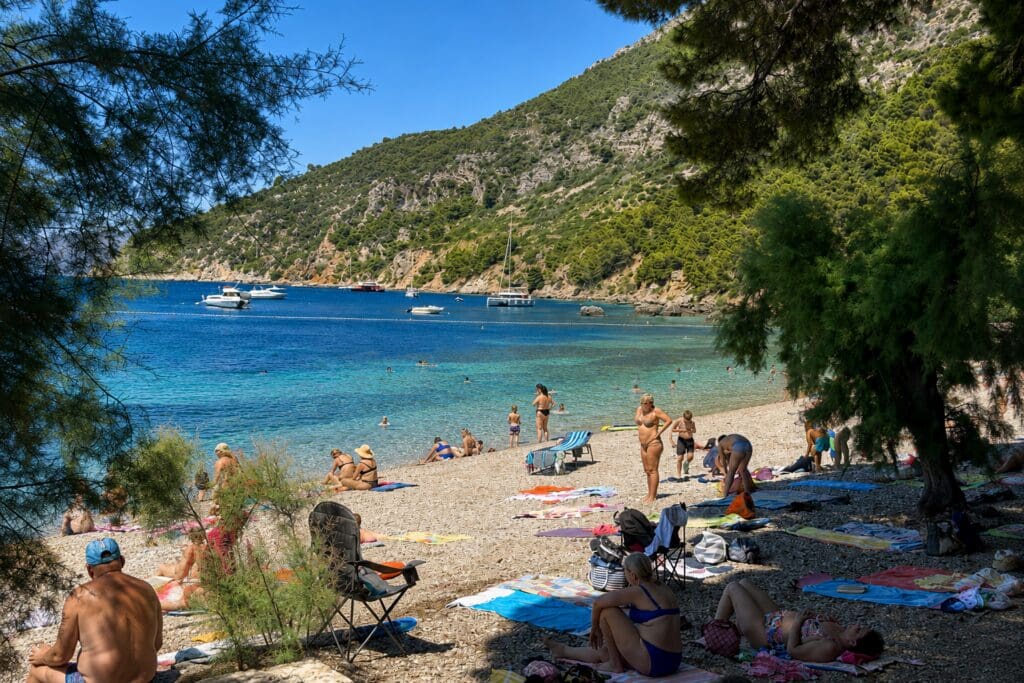
Vis is small and quiet, with vineyards, plenty of nature and considerably less polish than Hvar. That is largely the point.
When I visited Vis, I wasn’t staying there at all. We arrived by boat after visiting the Blue Cave on tiny Biševo and came into the harbor at Komiža. I loved it almost immediately. It was completely walkable and felt lived in rather than arranged for visitors. Across from the harbor, the beach filled with locals while cafés and restaurants tucked into the streets around it.
There are fewer high-end hotels on Vis than on Hvar, so someone looking for a traditional luxury resort stay may prefer another island. But that’s only one way to experience Vis. It can just as easily become part of a day on the water or a stop on a cruise or yacht itinerary.
For me, Komiža was proof that an island doesn’t need to become a hotel stay to become part of the trip.
Šolta: for something quieter
Šolta sits remarkably close to Split but receives a fraction of the attention given to neighboring Hvar and Brač.
The island is dotted with small villages, olive groves and coves, while Maslinica on its western end looks across a little archipelago of its own. This isn’t where I would send someone looking for a packed restaurant scene or a long list of things to do.
It is where I might send someone who likes the idea of having less to do.
Martinis Marchi gives Šolta an unexpected luxury anchor. The intimate hotel occupies an 18th-century castle beside its own marina in Maslinica. Arriving by private boat from Split seems an appropriately Croatian way to begin.
And what about Brač?
Brač is home to Zlatni Rat, the long, distinctive spit of pale pebbles that appears on what seems like every third photograph of Croatia.
It is certainly beautiful. It is also not, by itself, a reason I would choose an island.
Brač becomes more interesting if beaches and outdoor activities are priorities. For someone whose ideal island day involves plenty of time near the water, perhaps with some hiking, cycling or watersports mixed in, it may be exactly right.
There is good accommodation here, too. Hotel Lemongarden is a five-star hideaway in the fishing village of Sutivan, with historic stone buildings, gardens, a pool and its own private beach.
For someone primarily interested in food, wine and atmospheric old towns, however, I’d still look toward Korčula.
Do you have to choose just one?
Definitely not. In fact, one of Croatia’s great advantages is how naturally its islands can be combined.
But this is where island hopping can get out of hand.
A ten-day itinerary with five islands may look fantastic on paper. In practice, every move takes time. Even a relatively short transfer involves packing, checking out, getting to the port and settling into another hotel.
For a trip of roughly ten to fourteen days that also includes Split or Dubrovnik, I would generally rather see two or three islands done well than four or five done quickly.
Three nights gives you time to get past the arrival day. You get an evening after the day-trippers leave, a morning when you don’t have to be anywhere and enough time to venture inland rather than spending the entire visit within walking distance of the harbor.
Island hopping shouldn’t become island collecting.
But how you travel changes the answer

Everything above assumes, more or less, that you’re sleeping in hotels.
Put yourself on a yacht and the map changes.
Suddenly an island doesn’t need a wonderful hotel to earn a place on the itinerary. Vis becomes easy to incorporate. Mljet, with its forests, lakes and national park, becomes more compelling. Tiny Biševo can be somewhere you stop to see the Blue Cave rather than somewhere that ever needed to appear on a hotel search.
Then there are all the little harbors, coves and islands in between. They can become swimming spots, lunch stops or somewhere to anchor for the night rather than another check-in and check-out.
A yacht also removes one of the annoyances of conventional island hopping: your room travels with you.
That doesn’t automatically make it the better choice. If part of the pleasure for you is a beautiful hotel, a resort pool, lingering over dinner in town and wandering back to your room afterward, staying ashore may be exactly what you want.
But if you’re imagining waking somewhere different, swimming from the boat and having the freedom to experience places that don’t necessarily warrant a three-night hotel stay, Croatia is exceptionally well suited to being experienced from the water.
And you don’t have to choose one approach for the entire trip. A few nights on Hvar or Korčula paired with time on the water may turn out to be the sweet spot.
Which Croatian island is right for you?
| If you want… | Consider… |
| Luxury hotels, restaurants and energy | Hvar |
| Wine, food, history and old-town atmosphere | Korčula |
| Quiet, nature and a lived-in feel | Vis |
| Small scale and understated luxury | Šolta |
| Beaches and outdoor activity | Brač |
| Freedom to explore smaller islands and coves | A yacht |
This is really the same question I keep coming back to with Mediterranean islands: not which one is best, but which one is best for the trip you want.
The goal isn’t to fit as many islands as possible between Split and Dubrovnik. It’s to choose the places and pace that make sense for the way you want to travel.
And if that turns out to be two islands and a yacht? I can think of worse problems to have.
Have an island problem of your own? Tell me about it. I can help..


