
Antarctica is the last place on earth that doesn’t belong to anyone.
No country. No permanent population. No infrastructure built around ordinary life. What exists down there exists for the ice and the wildlife and the occasional scientist, and when you arrive, you are somewhere genuinely other in a way almost no destination can still deliver. That’s the thing people are chasing when they say Antarctica is on their list. Not a place. A different order of place.
I’ve been circling my own Antarctica trip for a while now, so I’ve been doing the homework in earnest, and what I’ve learned is that the hardest part isn’t deciding to go. It’s deciding how. Because an Antarctica cruise isn’t one trip. It’s a dozen different trips wearing the same coat, and the gap between them is enormous. Choose well and it’s the trip of your life. Choose without knowing what you’re choosing, and you can spend a great deal of money to be on the wrong ship for you.
So let me walk you through how I think about it. This is the stuff I’d talk through with you on a call, laid out so you can start sorting where you land.
The booking window is the first thing, because it’s the least forgiving
Start here, because this is the part that surprises people and the part with no give in it.
The ships are small on purpose. The guidelines that govern tourism down there hold shore landings to a hundred people at a time, which means the vessels are built to match. A ship carrying a hundred or a hundred and fifty passengers is not a mass-market product, and there aren’t many of them. The season is short, the brief austral summer from roughly November through March, and the departures inside it are limited from the start. They fill a year or more ahead. December, peak of the season and the holidays both, goes first.
Which means if Antarctica is on your list for the coming season, the conversation needs to happen now, not in the fall. And if you’re looking further out, you have a little more room, but less than you’d think. This is the rare trip where “someday” has a calendar attached to it.
The landings are the point
Everything else, the ship, the food, the lectures, the cabin, is the frame. The picture is the landings.
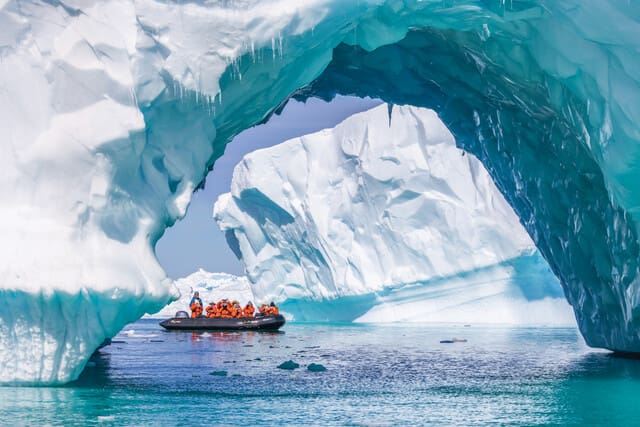
Here’s how it actually works. Small inflatable boats, called Zodiacs, ferry you from the ship to shore in small groups. You step off onto the ice and the rock and the black-sand beaches, and you walk among wildlife that has no reason to fear you and mostly can’t be bothered to. Penguins going about their business a few feet away. Seals draped across the ice like they own it. The scale of the place, the silence, the color of the ice, which is a blue you will not quite believe and will not quite capture, no matter how good your camera is.
That last part is worth sitting with, because it reframes the whole decision. If the landings are the point, then the question that matters most isn’t “which ship is nicest.” It’s “how much time will I actually spend off the ship, and what’s the experience when I’m on it.” Different operators answer that very differently.
The real decision: is the ship the point, or the expedition?
Once you understand that the landings are the experience, the operators sort themselves along one line, and knowing where you fall on it is most of the work. It isn’t about luxury versus not. Every operator worth booking is comfortable, well-run, and a world away from roughing it. The real question is where the emphasis sits.
On one end, the ship is a destination in its own right. Silversea and Seabourn run genuine Antarctica expeditions, Zodiacs and landings and all, but the vessel itself is part of the draw: the suites, the food, the service, the pleasure of coming in from the cold to something genuinely beautiful. For the traveler who wants the ice and wants the evening to be as good as the morning, this is the right answer. The Antarctic doesn’t care how nice your cabin is. You might, and you’re allowed to.
On the other end, the emphasis is on the expedition itself and the people who guide you through it. Lindblad Expeditions, in its long partnership with National Geographic, has the deepest pedigree here, naturalists and photographers aboard, an ethos built around the science, the wildlife, and the act of exploring. HX, formerly Hurtigruten Expeditions, sits in the same expedition-forward spirit, with purpose-built ships designed around getting you into the field. These are not lesser ships or lesser experiences. They’re comfortable and polished in their own right. They simply point everything at the expedition rather than at the vessel, and for a certain traveler that focus is exactly the appeal.
There’s one more thing size does, and it’s easy to miss until you’re aboard. It shapes how the trip feels. A smaller expedition ship, say a hundred or so passengers, has an intimacy the bigger ships can’t quite match. Everyone goes ashore in roughly one group, so there’s less queuing and a little more time on the ice. And the daily debrief, that evening gathering where the team walks through what you saw and what tomorrow might hold, is a different thing entirely in a room of a hundred than in a room of two hundred and twenty-five. On the smaller ships it feels like a conversation. The naturalists learn your name. By the third day you know the other guests. The bigger luxury ships give you more space, more room to disappear when you want to, and a more polished evening, and for some travelers that’s the better trade. But if the feeling of a small shared expedition is part of what you’re after, ship size is where you find it or lose it.
One thing worth knowing so the size question stays in perspective: nearly every serious operator aims for the same two landings a day, weather permitting. The single biggest variable in how much time you actually spend on the ice isn’t the line you chose. It’s the weather, which cancels a landing on the most beautiful ship as readily as on the plainest one.
The honest way to choose isn’t about money, though money is real and the lines do differ there. It’s about what you want the trip to be. Do you want Antarctica as the backdrop to a beautiful voyage, or the voyage built to deliver as much Antarctica as possible? Both are legitimate, and the whole point is knowing which one you’re after before you book. Get that clear and the right ship is easy to find.
Then there’s the route: Peninsula or the Circle
The other decision that shapes everything is where the ship actually goes.
Most Antarctica cruises cover the Antarctic Peninsula, and for good reason. It’s the accessible version, which is not a knock, it’s extraordinary, the icebergs and the penguin colonies and the dramatic scenery most people picture when they picture Antarctica. The Peninsula itineraries often deliver the richest concentration of landings and wildlife, more time doing the thing you came to do.
But there’s another option that comes with something even seasoned travelers notice: crossing the Antarctic Circle. The Circle sits at roughly 66 degrees south, and not every expedition reaches it. Getting there takes more time at sea and the right conditions, and it puts you in a genuinely small category of people who’ve done it. If that distinction matters to you, and for some travelers it very much does, it’s worth building the whole itinerary around. If what you want is the densest possible wildlife and scenery, the Peninsula usually gives you more of it. This is the exact decision I’m still working through for my own trip, and I go back and forth, which tells me it’s a real one.
A few things people don’t think to ask
Most Antarctica trips leave from Ushuaia, at the bottom of Argentina, which means you’re most of the way to some of the best of South America before you’ve even boarded. Pre- and post-trip extensions in Patagonia or Buenos Aires are easy to fold in and turn a single extraordinary trip into a fuller one. Worth thinking about the whole arc, not just the ship.
There’s also the Drake Passage, the stretch of open sea between South America and the Peninsula, which has a reputation for being rough and sometimes earns it. Some travelers fly over it instead, on “fly-the-Drake” itineraries that trade the crossing for a flight. That’s a real consideration depending on your stomach and your schedule, and it’s the kind of thing worth knowing about before you book, not after.
Where this leaves you
Antarctica is the rare trip where the planning genuinely changes the experience, not just the logistics. The ship you choose, the route you take, the time of season, whether you cross the Circle, whether you add Patagonia on the way, these aren’t details. They’re the trip.
That’s a lot to sort through, which is exactly why it’s worth sorting through with someone who’s already down the rabbit hole. I’m in it right now for my own trip, which means the research is fresh and the options are all sitting open on my desk.
If Antarctica is somewhere on your list, this year or someday, let’s talk about it. The earlier the better, for both of us. You can find me here: Let’s Chat


