
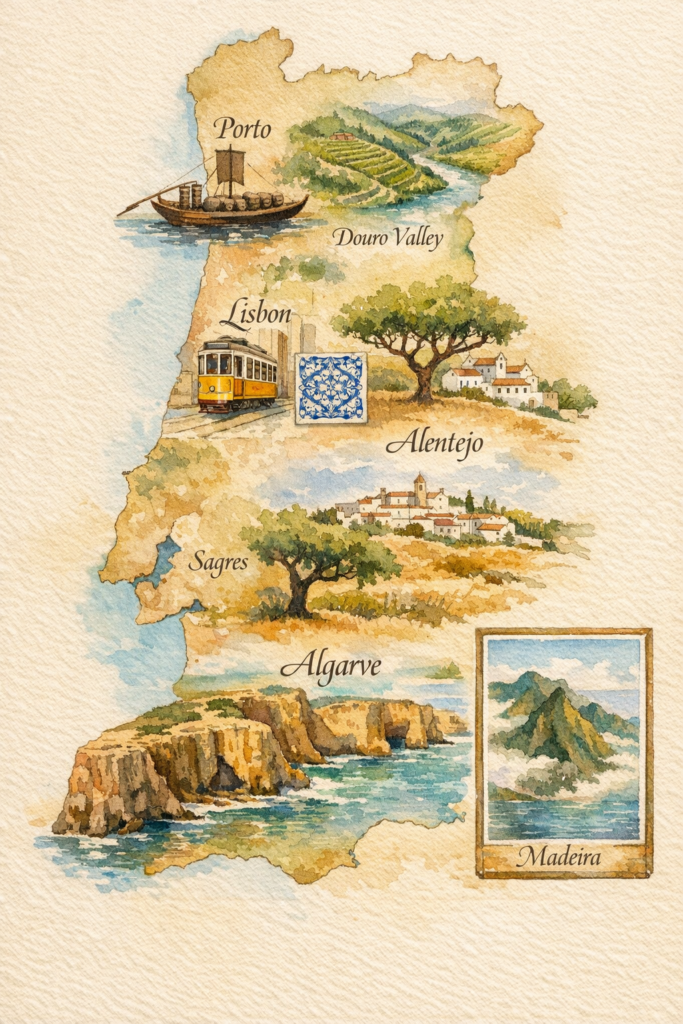
Portugal looks small on a map. It is not small.
That’s the first thing worth knowing before you start planning. The country is roughly the size of Indiana, which sounds manageable until you realize that the drive from the southern coast to the northern wine regions takes the better part of a day, and that’s before you’ve factored in the mountain roads, the medieval detours, or the afternoon you’ll lose in a café because the coffee was better than expected and nobody seemed to be in a hurry to leave.
Most first-time visitors try to do too much. They build an itinerary that touches Lisbon, Porto, Sintra, the Algarve, and the Douro Valley, all in ten days. What they end up with is a highlight reel rather than a trip. They saw the famous things. They didn’t have time to feel any of them.
The smarter question isn’t “what should I see in Portugal.” It’s “which Portugal am I actually looking for.” Because they’re not the same place.
Lisbon
Lisbon is the obvious starting point, and it deserves every superlative it gets. The city is built on seven hills, which means you’re always either climbing toward something or descending into something, and both directions tend to reward you. The Alfama district in the early morning, before the tour groups arrive, is one of those places that earns the word “ancient” without trying. Narrow streets, laundry on the lines, the distant sound of fado drifting from somewhere you can’t quite locate. Belém is where Portugal’s Age of Discovery lives in stone: the Jerónimos Monastery, the Tower of Belém, and Pastéis de Belém, which has been making the same custard tart since 1837 and still has a line out the door. For good reason.
Lisbon is also an exceptionally good base. Sintra is forty minutes by train, a day trip that feels like stepping into a fairy tale, all misty forests and eccentric palaces built by a nineteenth-century king with a passion for the romantic and the extravagant. You can spend a week in Lisbon and not run out of things to discover, which is the mark of a city that has been accumulating layers for a very long time.
Porto
Porto is a different temperament entirely. Smaller, grittier, more immediately itself. The old city climbs steeply above the Douro River, all narrow lanes and azulejo-tiled facades and the particular smell of river and rain that seems to cling to the place even on sunny days. The port wine lodges sit across the river in Vila Nova de Gaia, and a late afternoon tasting with the river below you and the sun going gold on the city across the water is one of those simple pleasures that stays with you longer than the grander moments tend to. Porto rewards slow travel. It is not a city you rush.
Douro Valley
From Porto, the Douro Valley is about an hour east, and it is one of the most beautiful landscapes in Europe. The river cuts through terraced hillsides planted with vines that have been here for centuries, and the whole thing has an ancient, unhurried quality that makes the modern world feel very far away. The best way to see it is by boat, or by driving the roads that wind along the ridges above the river. Either way, you’ll want more time than you think.
The Alentejo
The Alentejo is where Portugal gets quiet. It’s the large inland region south of Lisbon, largely overlooked by first-time visitors in favor of the coast, and that is precisely its appeal. Cork oak forests, rolling plains, white-walled villages that have barely changed in centuries. Évora is the anchor, a UNESCO World Heritage city with a Roman temple standing in the middle of it, essentially intact, two thousand years old, surrounded by cafés and daily life. The cathedral square on a quiet weekday morning has a stillness I haven’t found quite anywhere else. The Alentejo is for people who want to slow down enough to notice where they are. It attracts a certain kind of traveler, and if you’re reading this, you’re probably that kind of traveler.
The Algarve
The Algarve is the Portugal most people picture when they book the flight. Dramatic limestone cliffs, sea caves, golden beaches. It delivers on all of it. What it also delivers, especially in July and August, is crowds. I haven’t spent extensive time there myself, but what I know from clients and research is this: if beaches and coastline are what you’re coming for, the Algarve is genuinely spectacular. If you’re coming for the Portugal that feels like Portugal — the food, the pace, the particular melancholy of fado, the feeling that you’ve wandered somewhere that hasn’t been softened for tourists — you’ll find more of it elsewhere. The exception is Sagres, at the southwestern tip, where the cliffs meet the Atlantic and the wind comes in hard off the ocean and the whole place feels like the edge of the known world. That one is worth the drive regardless.
Madeira
And then there’s Madeira, which is technically Portugal but feels like its own planet. A volcanic island in the Atlantic, two hours by plane from Lisbon, with a landscape that goes from sea-level subtropical to misty mountain peaks in the space of a few miles. The Levada trails, irrigation channels built centuries ago that now serve as some of the most extraordinary hiking paths in the world, wind through the interior of the island in a way that makes you feel like you’ve wandered into a place that was made specifically to be beautiful. Madeira deserves more than a mention here, and I hope to write about it properly before long. For now: don’t overlook it.
When To Go
Timing matters enormously. May, June, September, and October are the months I recommend most consistently. The weather is reliable, the crowds are manageable, and the light in September and October has a particular quality that makes everything look like a painting. July and August are hot and crowded almost everywhere. December through February is quieter and mild by northern European standards, though some coastal areas slow down considerably.
Portugal is not interchangeable with itself. A week in Lisbon and a week in the Alentejo are two completely different trips in the same country. Before you start building an itinerary, it’s worth spending twenty minutes thinking about what you actually want from a trip. History and architecture? City life and food? Wine and landscape? Quiet and space? The answer shapes everything else.
And don’t try to do it all in one go. Portugal will still be there. The light on the walls of Évora will still do that thing at 4 p.m. The custard tarts will still be warm. The river will still be that color in the late afternoon. Come back. Most people do.
If you’re planning a trip to Portugal and want help thinking through the right regions and the right timing for the kind of trip you actually want, I’d love to help.


